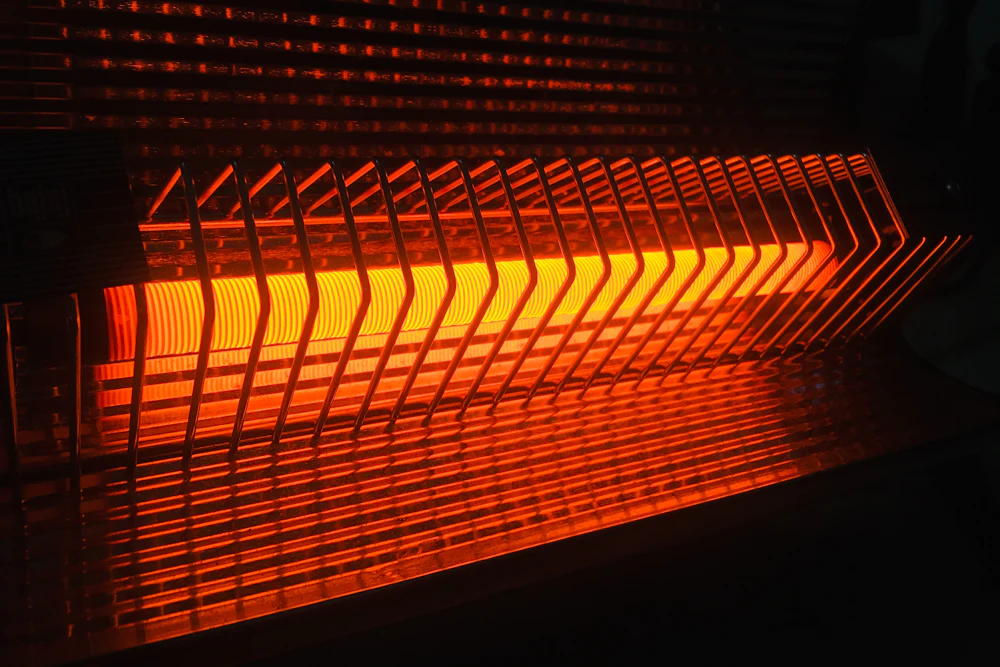
Space heaters are one of the most common ways Americans fight a cold room, and one of the most common reasons a winter electric bill comes in higher than expected. The good news is that their cost is easy to predict: almost every plug-in heater tops out at 1,500 watts, and every one of those watts becomes heat. This guide shows what a space heater costs per hour, per day and per month at today's prices, how much it can add to a winter bill, and the situations where it saves money compared with central heating.
Why nearly every heater is 1,500 watts
A standard U.S. household circuit runs at 120 volts and is protected by a 15-amp breaker. Electrical codes limit a continuous load to 80% of the breaker rating, about 1,440 watts, so manufacturers settle on 1,500 W as the maximum for portable heaters. Many have a low setting around 750 to 900 W. This is why a $30 fan heater and a $200 designer model cost the same to run on high: both convert 1.5 kW of electricity into about 5,100 BTU of heat per hour.
Types of heaters and what actually differs
- Fan-forced ceramic heaters heat a ceramic element and blow air across it. They warm a small room quickly.
- Oil-filled radiators heat sealed oil that radiates warmth slowly. They take longer to warm up but keep emitting heat after the element cycles off, so they feel steadier.
- Radiant and infrared heaters warm people and objects in front of them rather than the air, which can let you feel comfortable in a cooler room.
- "Heat pump" or "energy-saving" plug-in heaters are almost always ordinary resistance heaters. A true heat pump needs an outdoor unit.
All of these are 100% efficient at turning electricity into heat. None can deliver more heat per kWh than another. Claims of dramatic savings come from heating a smaller space or using a thermostat, not from the technology.
What a space heater costs per hour, day and month
The formula is the same as for any appliance: watts × hours ÷ 1,000 = kWh, then kWh × your price. At the U.S. average residential price of 18.16¢ per kWh (August 2026, EIA), compared with the cheapest and most expensive states:
| Use | kWh | U.S. average (18.2¢) | Nevada (12.7¢) | Hawaii (47.2¢) |
|---|---|---|---|---|
| 1 hour on high | 1.5 | $0.27 | $0.19 | $0.71 |
| 1 hour on low (750 W) | 0.8 | $0.14 | $0.10 | $0.35 |
| An evening: 4 hours, cycling 60% | 3.6 | $0.65 | $0.46 | $1.70 |
| Overnight: 8 hours on low | 6 | $1.09 | $0.76 | $2.83 |
| All day: 24 hours on high | 36 | $6.54 | $4.58 | $16.98 |
| Winter month: 6 h/day, 30 days, cycling 60% | 162 | $29.42 | $20.61 | $76.43 |
| Winter month: 8 h/day, 30 days, full power | 360 | $65.38 | $45.79 | $169.85 |
Worked example: a home office
You run a 1,500 W heater in a home office from 9 a.m. to 5 p.m., 22 working days a month. Once the room reaches the thermostat setting, the heater runs about 60% of the time.
- Average power: 1,500 W × 0.6 = 900 W.
- Energy per day: 0.9 kW × 8 hours = 7.2 kWh.
- Energy per month: 7.2 × 22 = 158 kWh.
- Cost: 158 × $0.1816 = $28.69 a month at the U.S. average.
How much a space heater adds to a winter bill
The average U.S. home used 863 kWh a month in 2024, according to the EIA. A heater used 8 hours a day at full power adds 360 kWh, over 40% of that average, and about $65.38 at today's national price. Two heaters running in bedrooms overnight can easily add more than the refrigerator, lighting and electronics combined. That is why households that rely on space heaters often see December and January bills 50 to 100% above their fall bills.
On a tiered rate, the effect is larger than the average price suggests: heater use usually pushes the bill into the top tier, so every extra kWh costs the higher price. On a time-of-use plan, evening heater use falls in the peak window on many winter plans.
Space heater vs. central heat: when it saves money
A space heater does not compete with your furnace on efficiency; it competes on how much space you heat. Heating one room to 70°F while letting the rest of the house fall to 62°F uses less total energy than heating every room to 70°F. Whether it saves money depends on what your central system is.
| Central heating system | Heat delivered per kWh or therm | Space heater zone heating |
|---|---|---|
| Electric baseboards or furnace | 1 kWh of heat per kWh | Saves money if it lets you heat fewer rooms |
| Heat pump (seasonal COP 2.5–3.5) | 2.5–3.5 kWh of heat per kWh | Usually costs more than letting the heat pump warm the room |
| Gas furnace (95%) | 27.8 kWh of heat per therm | Saves money only with a deep setback for the rest of the house |
| Oil or propane boiler/furnace | Varies with fuel price | Often worth it in shoulder seasons and for single rooms |
Worked comparison with a gas furnace
A furnace heating a whole house might use 3 therms on a cold day. Turning the thermostat down 8°F for the 10 hours you spend in one room could save perhaps 0.6 therms, about $1 at $1.60 a therm. Running a 1,500 W heater in that room for 10 hours at 60% duty uses 9 kWh, about $1.63 at today's U.S. average. In this example the heater costs more than it saves, unless your gas is expensive or your electricity is cheap. Run the same comparison with your own bills before assuming a heater helps.
Safety comes first
Space heaters are a leading cause of home heating fires. The U.S. Consumer Product Safety Commission and fire safety organizations recommend:
- Plug heaters directly into a wall outlet, never into an extension cord or power strip.
- Keep at least three feet of clearance from bedding, curtains, furniture and paper.
- Choose a model with tip-over and overheat shutoff and a recognized testing lab mark.
- Turn heaters off when you leave the room or go to sleep, unless the model is designed for unattended use.
- Do not run a heater on the same circuit as another large load; a warm plug or outlet is a warning sign.
Ten ways to cut what a space heater costs
- Use the built-in thermostat and set it a few degrees lower than you think you need.
- Use the low setting once the room is warm.
- Close the door of the room you are heating.
- Choose a radiant heater for a desk or chair, so it warms you instead of the whole room.
- Seal drafts around windows and doors with weatherstripping or a door sweep.
- Put a rug on bare floors; cold floors make a room feel colder than its air temperature.
- Use a timer to warm a bedroom for 30 minutes before bed instead of all night.
- On a time-of-use plan, warm the room before the evening peak and let the heater coast.
- Dress for the season: a sweater is worth several degrees of thermostat.
- If you heat rooms every winter, price a ductless mini-split: it heats the same room for a third to a half of the electricity.
Calculate your own cost
The space heater cost calculator is preloaded with a 1,500 W heater: set your hours, the share of time the element is on and your state, and it shows the cost per hour, day, month and year. To compare with a ductless heat pump, see the mini-split calculator, and for whole-house options read our guide to heat pump running costs by climate.
Frequently asked questions
How much does it cost to run a space heater all night?
A 1,500 W heater on high for 8 hours uses 12 kWh, about $2.18 at the U.S. average of 18.16¢. On low (750 W) or cycling on its thermostat about half the time, it uses roughly 6 kWh, around $1.09.
Are oil-filled radiators cheaper to run than ceramic heaters?
Not per hour at the same wattage: both turn every watt into heat. Oil-filled radiators warm up slowly and keep releasing heat after the element switches off, which can feel more even and may let the thermostat cycle less in a closed room. The cost difference comes from settings and how much space you heat, not the heater type.
Can a space heater lower my heating bill?
Yes, if you use it to heat one room while turning the central thermostat down for the rest of the house, and especially if your central system is electric resistance. It is usually not cheaper than a heat pump, which delivers two to four units of heat per unit of electricity, and only sometimes cheaper than gas.
Is it safe to leave a space heater on overnight?
Safety agencies advise turning heaters off when you sleep or leave the room unless the model is specifically designed for unattended use. Choose a heater with tip-over and overheat protection, plug it directly into a wall outlet, and keep three feet of clearance from anything that can burn.
Sources
- U.S. Department of Energy, Energy Saver – Estimating appliance and home electronic energy use (archived)
- EIA Electric Power Monthly, Table 5.6.A – Average price of electricity by state
- EIA Electric Sales, Revenue, and Average Price – 2024 average monthly bill (Table 5A)
- EIA 2020 Residential Energy Consumption Survey – end-use consumption (Tables CE5.3a, CE5.3b)