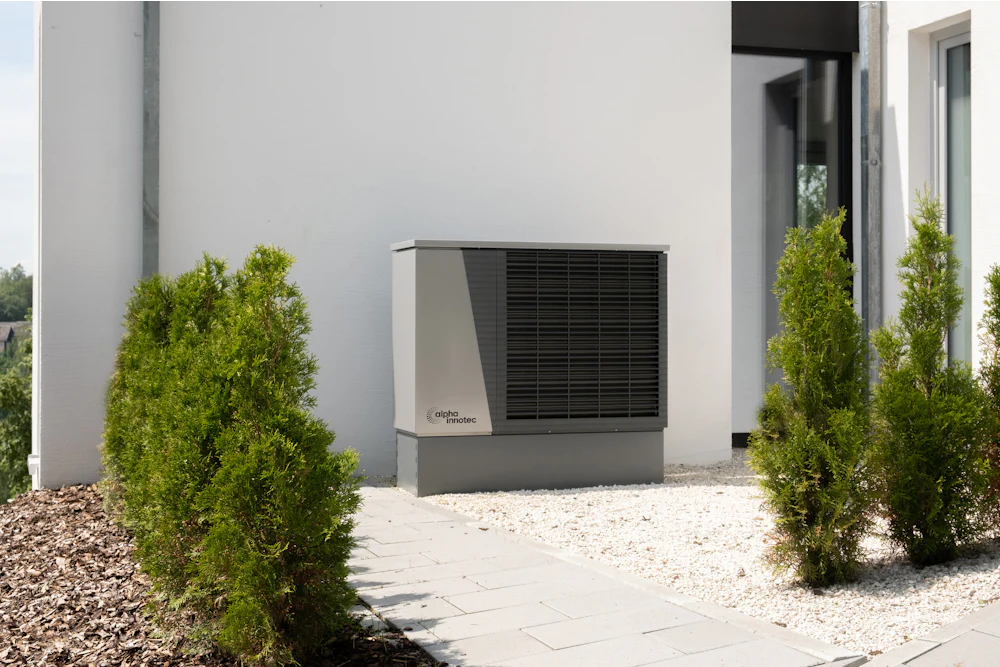
When an old air conditioner fails, many homeowners face the same question: replace it with another central AC, or with a heat pump that also heats the house? In summer the two are the same machine. A heat pump is an air conditioner with a reversing valve that lets it run the refrigeration cycle backward in winter, pulling heat from outdoor air into the house. So the running-cost comparison is really two questions. How much does each cost to cool? Almost exactly the same. How much does the heat pump cost to heat, compared with what you heat with now? That depends on your climate, your electricity price and your current fuel. This guide works through the numbers for five U.S. climate zones at the EIA's August 2026 average residential price of 18.16¢ per kWh.
Cooling: a tie between equals
Cooling efficiency is rated in SEER2 for both central air conditioners and heat pumps, and the federal minimums are nearly the same: about 13.4 SEER2 in the North and 14.3 SEER2 in the South and Southwest for new split-system air conditioners, and 14.3 SEER2 for heat pumps nationwide. A 3-ton unit of either type at the same rating draws the same power and removes the same heat. The yearly cooling cost is simply:
cooling load (BTU) ÷ SEER2 ÷ 1,000 = kWh, then × price per kWh
For a home that needs 18 million BTU of cooling a year, typical of the mid-Atlantic, a 15 SEER2 system uses 18,000,000 ÷ 15 ÷ 1,000 = 1,200 kWh, which costs $218 at today's national average. The EIA's household survey found that U.S. homes with air conditioning used about 2,318 kWh a year for it on average, with homes in the South using far more. If you choose a heat pump with the same SEER2, your summer bills will not change.
Heating: where the difference lies
A heat pump's heating efficiency is described by its coefficient of performance (COP): units of heat delivered per unit of electricity used. Electric resistance heat, such as baseboards, furnaces with heating strips or space heaters, has a COP of exactly 1. Modern heat pumps reach a COP of 3 to 4 in mild weather, and cold-climate models still manage about 2 at 5°F. Averaged over a heating season, the result is a seasonal COP of roughly 3 or more in the South and about 2 to 2.5 in the northern states.
How the heating math works
- Start with the house's yearly heating load in BTU. A 2,000-square-foot home in a cold climate might need 60 million BTU.
- Convert to kWh of heat: 60,000,000 ÷ 3,412 = 17,585 kWh.
- Divide by the seasonal COP: 17,585 ÷ 2.4 = 7,327 kWh of electricity.
- Multiply by your price: 7,327 × $0.1816 = $1,331 a year at today's U.S. average.
The same heat from electric resistance would take all 17,585 kWh, about $3,193. From a 95% efficient gas furnace it would take 60 million BTU ÷ 0.95 = 632 therms, about $1,011 at $1.60 per therm delivered.
Yearly running cost by climate zone
The table uses an illustrative 2,000-square-foot home with typical insulation, a 15 SEER2 system for cooling and a heat pump whose seasonal heating COP suits each climate. Electricity is priced at today's U.S. average of 18.16¢ and gas at $1.60 per therm. Your own home's loads can easily be 30% higher or lower.
| Climate | Cooling (either system) | Heat pump heating | Resistance heating | Gas furnace (95%) |
|---|---|---|---|---|
| Hot-humid (zone 1–2, e.g. Miami, Houston) | 2,667 kWh · $484 | 533 kWh · $97 | 1,758 kWh · $319 | 63 therms · $101 |
| Hot-dry (zone 2–3, e.g. Phoenix, Las Vegas) | 2,400 kWh · $436 | 916 kWh · $166 | 2,931 kWh · $532 | 105 therms · $168 |
| Mixed (zone 4, e.g. Atlanta, Washington D.C.) | 1,200 kWh · $218 | 3,664 kWh · $665 | 10,258 kWh · $1,863 | 368 therms · $589 |
| Cold (zone 5, e.g. Chicago, Denver) | 667 kWh · $121 | 7,327 kWh · $1,331 | 17,585 kWh · $3,193 | 632 therms · $1,011 |
| Very cold (zone 6–7, e.g. Minneapolis) | 400 kWh · $73 | 11,863 kWh · $2,154 | 24,912 kWh · $4,524 | 895 therms · $1,432 |
Three patterns stand out. First, in hot climates heating is a small share of the total, so a heat pump costs almost nothing extra over an AC and replaces a separate furnace. Second, compared with electric resistance heat, a heat pump cuts heating costs by 50 to 70% in every climate, which is the single biggest saving available to homes with baseboards or electric furnaces. Third, compared with natural gas, the answer depends on prices: in the cold and very cold rows, a heat pump at the national average electricity price costs somewhat more than gas, while in mild climates it is close to even or cheaper.
The break-even gas price
A useful shortcut: a therm of natural gas contains 29.3 kWh of heat, and a 95% furnace delivers about 27.8 kWh of it. A heat pump delivers that same heat from 27.8 ÷ COP kWh of electricity. At 18.16¢ per kWh, a heat pump with a seasonal COP of 3 matches gas at about $1.69 per therm; at a COP of 2.4 it matches gas at about $2.11. Check the total gas charge per therm on your bill, including delivery, which often doubles the commodity price. If you pay more than the break-even, the heat pump heats for less.
| Electricity price | Break-even gas price, COP 2.4 | Break-even gas price, COP 3.0 |
|---|---|---|
| 12¢/kWh | $1.39/therm | $1.11/therm |
| 16.5¢/kWh | $1.91/therm | $1.53/therm |
| 20¢/kWh | $2.32/therm | $1.86/therm |
| 30¢/kWh | $3.48/therm | $2.78/therm |
Things the averages miss
Backup heat
Most ducted heat pumps include electric resistance strips for very cold weather and for defrost cycles. If they come on often, seasonal efficiency falls sharply. Ask your installer to set an outdoor temperature lockout so the strips only run when the heat pump alone cannot keep up, and avoid deep thermostat setbacks that trigger them during recovery.
Sizing and ducts
A heat pump sized only for cooling may be too small for heating in the North, leaning on backup strips. A proper load calculation (Manual J) matters more than the brand. Leaky ducts in an attic or crawlspace waste the same share of heat in winter as cooling in summer.
Rate design
Some utilities offer lower winter prices for all-electric homes, larger winter baseline allowances on tiered rates or special heat pump rates. Others have a winter morning peak on time-of-use plans, which coincides with heating demand. Check your utility's options before deciding.
Dual-fuel systems
A heat pump paired with an existing gas furnace switches to gas below a set outdoor temperature. In cold climates with cheap gas, this captures most of the heat pump's savings in mild weather while avoiding its weakest hours.
Equipment cost and incentives
A heat pump usually costs somewhat more than a central AC of the same size, but less than an AC plus a new furnace. Federal tax credits, state programs and utility rebates often narrow or eliminate the difference, especially for ENERGY STAR cold-climate models. In homes that currently heat with electric resistance, propane or heating oil, the yearly savings commonly pay back the extra cost within a few years.
Run the numbers for your home
To estimate your own cooling cost, use the central air cost calculator with your system size, SEER2 and your state's rate. For a ductless system, use the mini-split heat pump calculator. If your gas bill shows the therms you used last winter, multiply them by 27.8, divide by the heat pump's expected seasonal COP and price the result in the electricity cost calculator to compare directly with what you paid for gas.
Frequently asked questions
Does a heat pump cost more to run than an air conditioner in summer?
No. In cooling mode a heat pump is an air conditioner, and both are rated with the same SEER2 scale. A heat pump and a central AC with the same capacity and SEER2 rating use the same electricity to cool the same house. Any difference in summer bills comes from the efficiency rating, sizing and installation quality, not from the type of system.
At what temperature does a heat pump stop being efficient?
There is no single cutoff. Efficiency falls gradually as the outdoor temperature drops. Standard heat pumps often reach a COP near 1.5 to 2 around 15 to 20°F and lean on backup resistance heat below that. Cold-climate models are designed to keep a COP around 2 at 5°F and keep heating, with reduced capacity, well below 0°F. Even at a COP of 1.5 a heat pump uses a third less electricity than resistance heat.
How much does it cost to heat a house with a heat pump per month?
It depends on the home's heat loss and the climate. A whole-house heat pump averaging 3 kW for 8 hours a day uses 720 kWh a month, about $130.75 at the U.S. average rate of 18.16¢. A well-insulated home in a mild climate might use half that; a large, older home in a cold climate could use two to three times as much in January.
Should I replace a working gas furnace with a heat pump?
Not necessarily right away. If your air conditioner is failing, replacing it with a heat pump and keeping the furnace as backup (a dual-fuel system) captures most of the savings in mild weather with little risk. Replacing a furnace that still works makes the most financial sense when gas is expensive, electricity is cheap, or incentives cover much of the cost.