Cost to run an electric kettle in every state
For 1,500 W for 0.1 hours a day, 30 days a month, at each state's average residential electricity rate (August 2026, EIA). Click a state for more detail.
| State | Rate | Per hour | Per month | Per year |
|---|---|---|---|---|
| Nevada | 12.72¢ | $0.19 | $0.57 | $6.87 |
| Louisiana | 12.87¢ | $0.19 | $0.58 | $6.95 |
| North Dakota | 13.31¢ | $0.20 | $0.60 | $7.19 |
| Utah | 13.31¢ | $0.20 | $0.60 | $7.19 |
| Idaho | 13.37¢ | $0.20 | $0.60 | $7.22 |
| Tennessee | 13.42¢ | $0.20 | $0.60 | $7.25 |
| Nebraska | 13.54¢ | $0.20 | $0.61 | $7.31 |
| Kentucky | 13.80¢ | $0.21 | $0.62 | $7.45 |
| Arkansas | 14.37¢ | $0.22 | $0.65 | $7.76 |
| Mississippi | 14.43¢ | $0.22 | $0.65 | $7.79 |
| Wyoming | 14.43¢ | $0.22 | $0.65 | $7.79 |
| Washington | 14.63¢ | $0.22 | $0.66 | $7.90 |
| Oklahoma | 14.82¢ | $0.22 | $0.67 | $8.00 |
| North Carolina | 14.95¢ | $0.22 | $0.67 | $8.07 |
| Florida | 14.99¢ | $0.22 | $0.67 | $8.09 |
| Arizona | 15.05¢ | $0.23 | $0.68 | $8.13 |
| South Dakota | 15.15¢ | $0.23 | $0.68 | $8.18 |
| Kansas | 15.47¢ | $0.23 | $0.70 | $8.35 |
| Montana | 15.57¢ | $0.23 | $0.70 | $8.41 |
| South Carolina | 15.76¢ | $0.24 | $0.71 | $8.51 |
| Georgia | 15.90¢ | $0.24 | $0.72 | $8.59 |
| Texas | 15.91¢ | $0.24 | $0.72 | $8.59 |
| Oregon | 15.92¢ | $0.24 | $0.72 | $8.60 |
| Missouri | 16.02¢ | $0.24 | $0.72 | $8.65 |
| West Virginia | 16.31¢ | $0.24 | $0.73 | $8.81 |
| Alabama | 16.33¢ | $0.24 | $0.73 | $8.82 |
| New Mexico | 16.51¢ | $0.25 | $0.74 | $8.92 |
| Indiana | 17.02¢ | $0.26 | $0.77 | $9.19 |
| Iowa | 17.06¢ | $0.26 | $0.77 | $9.21 |
| Colorado | 17.17¢ | $0.26 | $0.77 | $9.27 |
| Minnesota | 17.20¢ | $0.26 | $0.77 | $9.29 |
| Virginia | 17.64¢ | $0.26 | $0.79 | $9.53 |
| Delaware | 18.70¢ | $0.28 | $0.84 | $10.10 |
| Illinois | 19.32¢ | $0.29 | $0.87 | $10.43 |
| Ohio | 19.38¢ | $0.29 | $0.87 | $10.47 |
| Wisconsin | 19.41¢ | $0.29 | $0.87 | $10.48 |
| Maryland | 21.40¢ | $0.32 | $0.96 | $11.56 |
| Pennsylvania | 21.77¢ | $0.33 | $0.98 | $11.76 |
| Michigan | 22.99¢ | $0.34 | $1.03 | $12.41 |
| Vermont | 23.84¢ | $0.36 | $1.07 | $12.87 |
| Connecticut | 24.51¢ | $0.37 | $1.10 | $13.24 |
| New Jersey | 24.61¢ | $0.37 | $1.11 | $13.29 |
| District of Columbia | 25.98¢ | $0.39 | $1.17 | $14.03 |
| New Hampshire | 27.64¢ | $0.41 | $1.24 | $14.93 |
| Rhode Island | 28.18¢ | $0.42 | $1.27 | $15.22 |
| New York | 28.65¢ | $0.43 | $1.29 | $15.47 |
| Alaska | 29.41¢ | $0.44 | $1.32 | $15.88 |
| California | 29.75¢ | $0.45 | $1.34 | $16.07 |
| Massachusetts | 30.48¢ | $0.46 | $1.37 | $16.46 |
| Maine | 32.11¢ | $0.48 | $1.44 | $17.34 |
| Hawaii | 47.18¢ | $0.71 | $2.12 | $25.48 |
How the cost is calculated
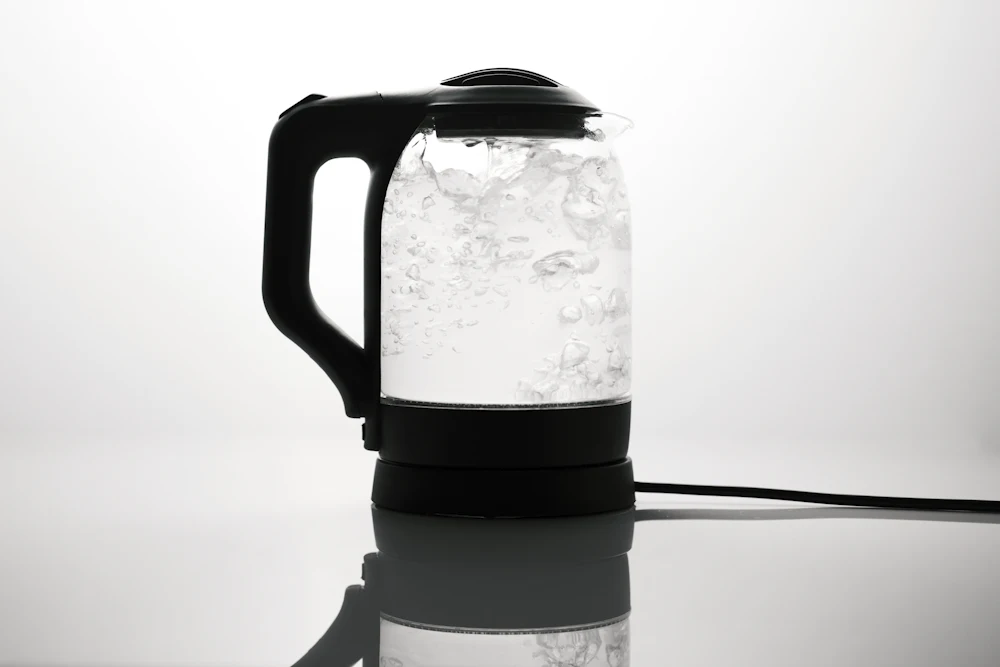
The Department of Energy's formula: watts × hours per day ÷ 1,000 = kWh per day. Multiply by the days you use it and by your rate in dollars per kWh. A 1,500 W device running 1 hour uses 1.5 kWh; at 18¢ that is 27¢.
How to lower the cost
- Boil only the water you need.
- Descale it regularly: limescale makes it slower.
- It usually uses less energy than heating water on an electric stove.