Every electric bill in the United States charges you for the same thing: kilowatt-hours, written kWh. It is the unit utilities use to measure how much electricity you used, and once you understand it you can work out what any appliance in your home costs to run.
Watts, kilowatts and kilowatt-hours
A watt (W) measures power: how fast a device uses electricity at a given moment. A kilowatt (kW) is simply 1,000 watts. Neither of those is what you pay for. You pay for energy, which is power multiplied by time.
One kilowatt-hour is the energy used by something drawing 1,000 watts for one hour. The same kWh can be spread out or used quickly. Each of these uses exactly 1 kWh:
- A 10 W LED bulb running for 100 hours
- A 100 W TV running for 10 hours
- A 1,000 W microwave running for 1 hour
- A 1,500 W space heater running for 40 minutes
- A 3,000 W electric oven element running for 20 minutes
A useful way to picture it: watts are like the speed of a car, and kilowatt-hours are like the miles driven. A powerful heater "drives fast" and racks up kWh quickly; a phone charger crawls along and takes days to use one.
The formula
To find how many kWh something uses, the U.S. Department of Energy uses this formula:
watts × hours of use ÷ 1,000 = kWh
Then multiply by your price per kWh to get the cost:
kWh × price per kWh = cost
Example: a 1,500 W space heater running 6 hours uses 1,500 × 6 ÷ 1,000 = 9 kWh. At the U.S. average residential price of 18.16¢ per kWh, that is about $1.63 for the day.
How much does one kWh cost?
It depends a lot on where you live. In August 2026, the average U.S. household paid 18.16¢ per kWh, according to the U.S. Energy Information Administration (EIA). The cheapest state was Nevada at 12.72¢, and the most expensive was Hawaii at 47.18¢, more than 3 times as much.
The same hour of use therefore costs very different amounts across the country:
| 1 kWh used by… | U.S. average | Nevada | Hawaii |
|---|---|---|---|
| A 10 W LED bulb, 100 hours | 18¢ | 13¢ | 47¢ |
| A 100 W TV, 10 hours | 18¢ | 13¢ | 47¢ |
| A 1,000 W microwave, 1 hour | 18¢ | 13¢ | 47¢ |
| A 1,500 W space heater, 40 minutes | 18¢ | 13¢ | 47¢ |
| A 3,000 W electric oven element, 20 minutes | 18¢ | 13¢ | 47¢ |
The state averages are total residential revenue divided by kWh sold, so they include delivery charges and fees spread over every kWh. Your own bill shows your exact price; our guide to reading your electric bill explains how to find it.
How many kWh does a home use?
The average U.S. home used about 863 kWh a month in 2024, for an average bill of $142.26, according to EIA. That is roughly 29 kWh a day. Homes in hot Southern states use far more because of air conditioning, and homes with electric heat use more in winter. See the average electric bill in every state for local figures.
kWh vs. other energy units
- Megawatt-hour (MWh): 1,000 kWh. Used for power plants and large buildings, and roughly what a typical home uses in a month or two.
- Therm: the unit on natural gas bills. One therm is 100,000 BTU, about 29.3 kWh of heat.
- BTU: British thermal unit, common on air conditioners and furnaces. 1 kWh equals about 3,412 BTU.
Worked example: a month of kWh in one home
Adding up a few appliances shows how quickly kWh accumulate, and which ones matter. Take a household with these habits over a 30-day month:
- Refrigerator: about 1.7 kWh a day, the EIA's average for a main refrigerator, so 51 kWh.
- Ten 9 W LED bulbs for 4 hours a day: 10 × 9 × 4 ÷ 1,000 = 0.36 kWh a day, 10.8 kWh.
- A 100 W TV for 5 hours a day: 0.5 kWh a day, 15 kWh.
- An electric dryer, 3 kWh a load, 12 loads: 36 kWh.
- Central air conditioning, 2.5 kW for 8 hours a day: 20 kWh a day, 600 kWh.
Total: about 713 kWh, and the air conditioner accounts for 84% of it. At the U.S. average of 18.16¢, the month costs $129.48; the lights and TV together cost only $4.69. That pattern holds in most homes: heating, cooling, water heating and a few large appliances set the bill, while small electronics and LED lighting barely move it.
Where kWh are measured: your meter
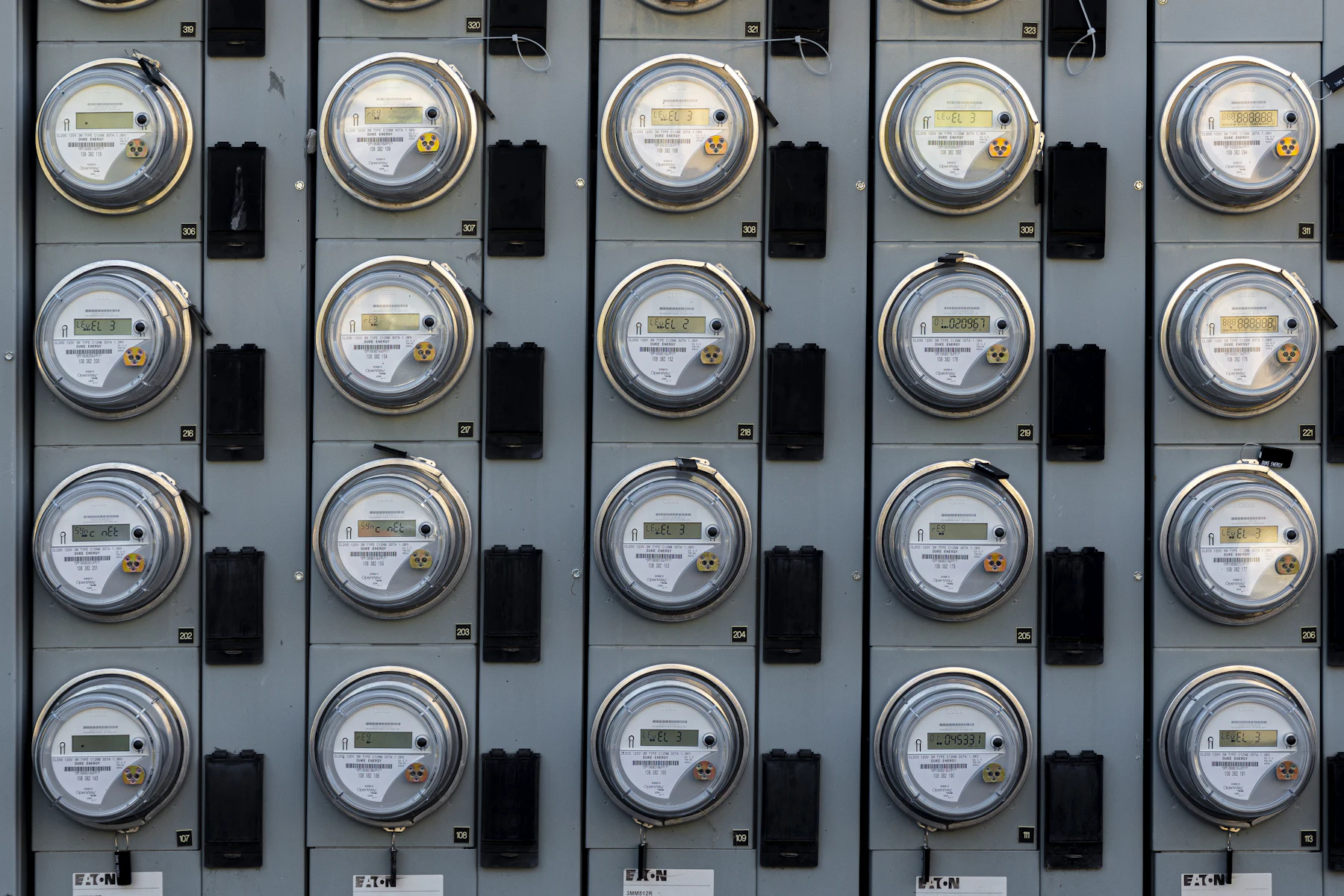
Your electric meter counts kWh continuously, much like a car's odometer counts miles. Older mechanical meters have spinning dials that a meter reader records each month; the bill shows the difference between two readings. Most U.S. homes now have smart meters, which record usage in 15-minute or hourly intervals and send it to the utility automatically. That interval data is usually available on your utility's website or app, and it is the best tool for understanding your own kWh: you can see the jump when the air conditioner starts, the overnight baseload of everything that never turns off, and the effect of any change you make.
kWh on a solar home's bill
If you have rooftop solar, the meter also counts kWh you send to the grid. Depending on your utility's rules, the bill may show kWh delivered, kWh received and the net, with exported kWh credited at the retail price or at a lower export rate. Either way, the unit is the same kilowatt-hour.
Common questions
Is kW the same as kWh?
No. kW is a rate (how fast electricity is used right now); kWh is an amount (how much was used over time). Your bill charges for kWh. Some commercial bills also charge for peak kW, called a demand charge, but most home bills do not.
How do I find an appliance's wattage?
Look for the rating plate or label on the back or bottom of the device, or in the manual. It is listed in watts (W), or in volts and amps: multiply volts × amps to get watts. Our appliance wattage chart lists typical values.
Why does my fridge use less than its wattage suggests?
Appliances with a thermostat, like refrigerators, freezers and water heaters, switch on and off. For those, the yearly kWh on the yellow EnergyGuide label is a better guide than the wattage.
Frequently asked questions
How many kWh are on a typical electric bill?
The average U.S. home used about 863 kWh a month in 2024, according to the EIA, but a small apartment may use 400 kWh and a large all-electric house in a hot or cold climate 2,000 kWh or more. The kWh used appears near the top of your bill, usually with a 12-month history chart.
How much is 1 kWh of electricity?
It depends on where you live. The U.S. average residential price was 18.16¢ per kWh in August 2026, according to the EIA, but state averages range from about 12¢ to over 40¢. Your own bill shows your price, and dividing the total bill by the kWh used gives your all-in average.
What can 1 kWh power?
About 10 hours of a 100 W device, 100 hours of a 10 W LED bulb, 40 minutes of a 1,500 W space heater, roughly one load in a modern dishwasher, a full charge of a laptop around 15 to 20 times, or 3 to 4 miles of driving in a typical electric car.
How do I convert watts to kWh?
Multiply the watts by the hours of use and divide by 1,000. A 60 W bulb on for 5 hours uses 60 × 5 ÷ 1,000 = 0.3 kWh. For a monthly figure, multiply the daily kWh by the number of days you use the device.