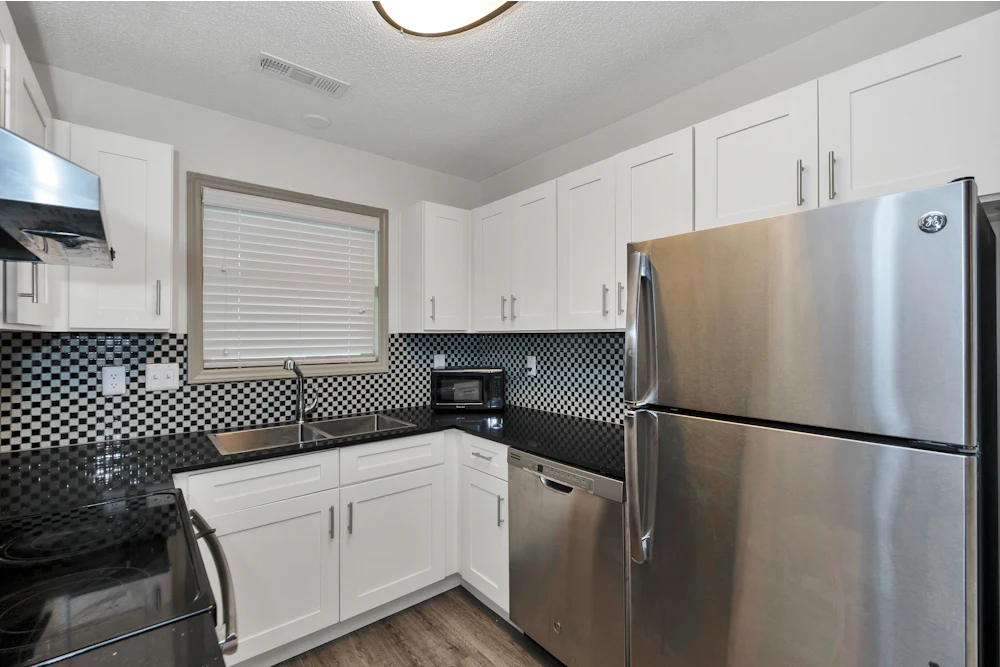
Most appliances run when you use them. Three run whether you think about them or not: the refrigerator, the freezer and the water heater. They are on 24 hours a day, 365 days a year, and together they can account for a third of the electricity in a home with an electric water heater. Because they never stop, small differences in efficiency add up to real money over the 10 to 20 years each one lasts. This guide breaks down what each uses, based on the U.S. Energy Information Administration's Residential Energy Consumption Survey (RECS), what that costs at the August 2026 average price of 18.16¢ per kWh, and which changes are worth making.
The annual numbers
The RECS measures how much electricity real homes use for each end use, not what a label says. These are the national averages for homes that have each appliance:
| Appliance | kWh per year | kWh per month | Cost per year at 18.2¢ | Share of an average home's use |
|---|---|---|---|---|
| Main refrigerator | 617 | 51 | $112.05 | 6% |
| Second refrigerator | 494 | 41 | $89.71 | 5% |
| Separate freezer | 570 | 48 | $103.51 | 6% |
| Electric water heater | 2,706 | 226 | $491.41 | 26% |
For context, the average U.S. home used about 10,356 kWh in 2024. A home with a main refrigerator, a garage fridge, a chest freezer and an electric water heater spends roughly 4,387 kWh a year, about $796.68, on these four appliances alone.
Refrigerators: steady, predictable, often duplicated
How they use power
A refrigerator's compressor cycles on and off to hold the set temperature, drawing 100 to 250 W while it runs. Frost-free models also run a defrost heater several times a day. Averaged over a day, a modern full-size refrigerator draws only about 40 to 80 W. The EnergyGuide label lists the measured kWh per year, usually 350 to 650 for new models.
Why the average is higher than the label
The RECS average of 617 kWh for main refrigerators is higher than a new label because the fleet includes older models, larger side-by-side units with through-the-door ice, refrigerators in warm kitchens and doors opened dozens of times a day. Second refrigerators average 494 kWh, and many are older units in garages where summer heat makes them work much harder.
Worked example
A refrigerator rated 450 kWh a year uses 450 ÷ 365 = 1.23 kWh a day, an average of 1,230 ÷ 24 = 51 W. At 18.16¢ it costs 450 × $0.1816 = $81.72 a year, or $6.81 a month.
Freezers: chest beats upright
A separate freezer averages 570 kWh a year in RECS homes. Design matters more than size: chest freezers lose little cold air when opened and most have no defrost heater, so a new 7 cubic foot chest model may be rated near 220 kWh a year, while a large upright frost-free freezer can be rated 600 kWh or more. Location is the other big factor. A freezer in a 90°F garage runs far longer than one in a 65°F basement.
Water heaters: the big one
Electric water heating averages 2,706 kWh a year in homes that use it, more than the refrigerator, freezer and second fridge combined. A standard tank heats water with 4,500 W elements, which switch on after hot water is drawn and to make up heat lost through the tank walls. Most of the energy goes into showers, followed by clothes washing, dishwashing and sinks.
Worked example: the heat in a shower
- A 10-minute shower at 1.8 gallons per minute uses 18 gallons, about two thirds of it hot water at 120°F: 12 gallons.
- Raising 12 gallons from 55°F to 120°F takes 12 × 8.34 lb × 65°F = 6,505 BTU.
- That is 6,505 ÷ 3,412 = 1.9 kWh, or about 2.1 kWh after tank losses.
- At 18.16¢, each shower costs about $0.38; two a day for a year is 1,533 kWh, $278.39.
Regional differences
Climate changes all three. Inlet water is colder in the North, so heating it takes more energy; garages and kitchens are hotter in the South, so refrigerators and freezers work harder. Annual kWh for homes with each appliance, by census region (RECS 2020):
| Region | Refrigerator | Freezer | Water heating |
|---|---|---|---|
| New England | 547 | 452 | 2,124 |
| Middle Atlantic | 565 | 518 | 2,528 |
| East North Central | 608 | 530 | 2,673 |
| West North Central | 613 | 572 | 2,870 |
| South Atlantic | 652 | 600 | 2,767 |
| East South Central | 630 | 644 | 2,958 |
| West South Central | 643 | 646 | 2,766 |
| Mountain North | 626 | 557 | 2,881 |
| Mountain South | 655 | 577 | 2,340 |
| Pacific | 612 | 541 | 2,588 |
Which upgrades pay back
Yearly savings at today's U.S. average price. Lifetimes are typical: 12 to 15 years for refrigerators and freezers, 10 to 15 years for water heaters.
| Change | kWh before | kWh after | Saved per year |
|---|---|---|---|
| 1990s refrigerator → new ENERGY STAR | 1,050 | 400 | 650 kWh · $118.04 |
| Garage second fridge → unplugged | 494 | 0 | 494 kWh · $89.71 |
| Old upright frost-free freezer → new chest | 900 | 250 | 650 kWh · $118.04 |
| Electric tank → heat pump water heater | 2,706 | 900 | 1,806 kWh · $327.97 |
| Water heater at 140°F → 120°F | 2,706 | 2,435 | 271 kWh · $49.14 |
The two standouts are free or nearly free: unplugging a lightly used second refrigerator, and turning the water heater down to 120°F, the setting the Department of Energy recommends. The biggest single saving comes from a heat pump water heater, which uses roughly a third of the electricity of an element tank; with federal tax credits and utility rebates, many pay back within a few years in homes that use a lot of hot water.
Reading the EnergyGuide label
Every new refrigerator, freezer and water heater sold in the U.S. carries a yellow EnergyGuide label. For refrigerators and freezers it shows the estimated yearly electricity use in kWh and an estimated yearly cost, calculated at a national reference price that is usually lower than today's rates. Ignore the dollar figure and multiply the kWh by your own price instead. The label also shows a range for similar models, so you can see at a glance whether a model is efficient for its size and style. For water heaters, the label shows the yearly energy use and the first-hour rating, which tells you how much hot water the tank can deliver in a busy hour. Comparing kWh per year between two models and multiplying the difference by your price and by 12 to 15 years gives the lifetime savings that justify, or not, a higher purchase price.
How to measure your own
- Refrigerators and freezers: plug them into an inexpensive energy meter for a week. Divide the kWh by 7 and multiply by 365 for a yearly figure.
- Water heaters: they are hardwired at 240 V, so a plug-in meter will not work. Compare your bills in months when you are home and when you are away, or check whether your utility's app breaks out water heating.
- Labels: the EnergyGuide label on any refrigerator, freezer or water heater lists estimated yearly kWh under standard test conditions, a good starting point when shopping.
Maintenance that keeps the numbers down
- Vacuum refrigerator condenser coils once or twice a year.
- Check door gaskets with the dollar-bill test.
- Set the refrigerator to about 37°F and the freezer to 0°F.
- Defrost manual freezers before ice exceeds a quarter inch.
- Drain a few gallons from the water heater yearly to clear sediment.
- Insulate the first few feet of hot water pipe at the tank.
- Fix dripping hot water faucets; a drip a second wastes over 1,000 gallons a year.
Calculate your own costs
Enter the kWh from your EnergyGuide label or energy meter in the refrigerator, freezer or water heater calculators and choose your state to see the yearly cost at your rate.
Frequently asked questions
How many kWh does a refrigerator use per day?
A modern full-size refrigerator uses about 1 to 2 kWh a day. The EIA's survey average for a main refrigerator is about 617 kWh a year, or 1.7 kWh a day. Older models, side-by-side units with ice makers and refrigerators in hot garages use more, sometimes 3 kWh a day or higher.
Is it cheaper to run a chest freezer or an upright?
A chest freezer of the same capacity usually uses 25 to 40% less, because cold air stays inside when the lid opens and most chest models are manual defrost with no defrost heater. Uprights are easier to organize; if you choose one, an ENERGY STAR model with a good door seal narrows the gap.
How long does an electric water heater run each day?
Typically two to four hours of total element time for a family, spread through the day after showers, laundry and dishes, plus short cycles to make up standby heat loss. A household that uses little hot water may need under an hour; a large family with long showers can need five or more.
What temperature should a water heater be set to?
The Department of Energy recommends 120°F for most homes. It saves energy by reducing standby losses and lowers scalding risk. Some households with dishwashers that lack a booster heater or with specific health needs may choose a higher setting; check with a professional if unsure.
Sources
- EIA 2020 Residential Energy Consumption Survey – end-use consumption (Tables CE5.3a, CE5.3b)
- U.S. Department of Energy, Energy Saver – Estimating appliance and home electronic energy use (archived)
- EIA Electric Sales, Revenue, and Average Price – 2024 average monthly bill (Table 5A)
- EIA Electric Power Monthly, Table 5.6.A – Average price of electricity by state