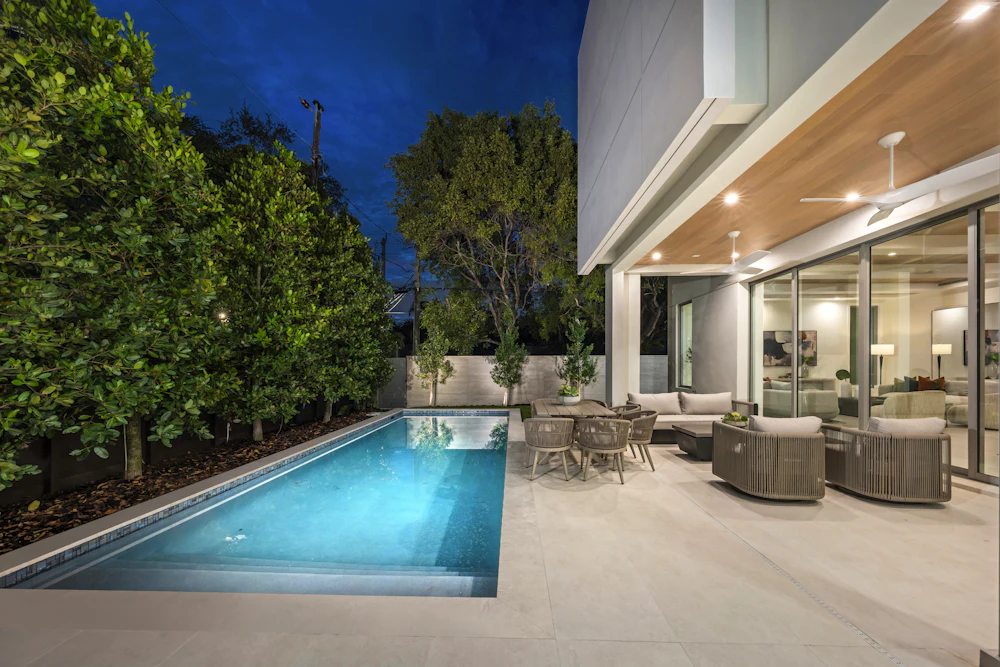
A backyard pool or hot tub is one of the most expensive things a home can plug in. The EIA's Residential Energy Consumption Survey found that homes with a pool pump used about 2,384 kWh a year to run it, and homes with a hot tub about 1,963 kWh a year for its pumps and heater. Together that is more than a third of what an average U.S. home uses for everything (10,356 kWh a year). At the August 2026 average residential price of 18.16¢ per kWh, that is $432.93 and $356.48 a year. The good news is that both are among the most controllable loads in a home: the right equipment and a sensible schedule can cut their cost by half or more.
Part 1: pool pumps
How a pool pump uses electricity
The pump pulls water from the skimmer and main drain, pushes it through the filter, heater and chlorinator, and returns it to the pool. It does not cycle on a thermostat: it runs at a constant power for as long as the timer allows. So the monthly energy is simply watts × hours × days.
The kind of motor makes an enormous difference. A single-speed pump runs flat out every minute it is on, typically drawing 1,000 to 2,500 W. A variable-speed pump uses a permanent-magnet motor and can run at any speed. Pump physics, described by the affinity laws, is strongly in its favor: flow falls in proportion to speed, but power falls with roughly the cube of speed. At half speed, a pump moves half the water for about an eighth of the power. Running twice as long at half speed moves the same total water for about a quarter of the energy, and the slower flow filters better too.
Federal efficiency standards for pool pumps that took effect in July 2021 effectively require variable-speed motors for most new replacement filtration pumps, so anyone replacing an old pump today will usually end up with one.
Monthly cost by pump type
All rows move roughly the same volume of water for an average residential pool.
| Pump and schedule | kWh/month | 12¢ | U.S. average (18.2¢) | 30¢ |
|---|---|---|---|---|
| Single-speed, 1.5 hp (1,800 W), 8 h/day | 432 | $51.84 | $78.45 | $129.60 |
| Single-speed, 1 hp (1,200 W), 8 h/day | 288 | $34.56 | $52.30 | $86.40 |
| Two-speed, low speed 450 W, 12 h/day | 162 | $19.44 | $29.42 | $48.60 |
| Variable-speed, 300 W, 12 h/day | 108 | $12.96 | $19.61 | $32.40 |
| Variable-speed, 150 W, 20 h/day | 90 | $10.80 | $16.34 | $27.00 |
Worked example: how long to run the pump
- Find your pool's volume. A 16 × 32 foot pool averaging 5 feet deep holds 16 × 32 × 5 × 7.48 = about 19,150 gallons.
- Aim for one turnover a day, a common rule for residential pools with good chemistry.
- At 40 gallons per minute, one turnover takes 19,150 ÷ 40 = 479 minutes, about 8 hours.
- On a variable-speed pump, 40 gpm might need only 400 W instead of the 1,800 W a single-speed pump draws at full speed: 0.4 kW × 8 h × 30 days = 96 kWh a month, about $17.43, versus 432 kWh ($78.45) for the single-speed.
Cutting pool pump costs
- Program a low speed for daily filtering and higher speeds only for vacuuming, cleaners or spa jets.
- Run fewer hours in cool months when algae grows slowly.
- Empty skimmer and pump baskets weekly and clean the filter when its pressure rises 8 to 10 psi above clean.
- Keep the pool covered to reduce debris, evaporation, chemical use and heat loss.
- Check utility rebates before buying a pump; many pay $100 to $300 toward a variable-speed model.
Part 2: hot tubs
How a hot tub uses electricity
A hot tub has a resistance heater, usually 4,000 to 5,500 W on a 240-volt circuit (or 1,000 to 1,500 W on 120-volt plug-in models), a circulation pump that runs many hours a day, and jet pumps that run only when someone is in it. The heater is thermostat-controlled and does most of the work, replacing heat lost through the cover, the cabinet and, above all, the open surface when the cover is off. The RECS split for an average tub is about 1,479 kWh a year for heating and 484 kWh for pumps.
Monthly cost by season and cover
| Situation | kWh/month | 12¢ | U.S. average (18.2¢) | 30¢ |
|---|---|---|---|---|
| Mild month, good cover | 120 | $14.40 | $21.79 | $36.00 |
| Typical month (EIA RECS average) | 164 | $19.63 | $29.71 | $49.08 |
| Cold month, good cover | 300 | $36.00 | $54.48 | $90.00 |
| Cold month, worn cover | 500 | $60.00 | $90.80 | $150.00 |
| 120 V plug-and-play tub, cold month | 350 | $42.00 | $63.56 | $105.00 |
Plug-and-play tubs look cheaper because their heaters are small, but in cold weather a small heater may run almost continuously to keep up, and the tub reheats slowly after use.
Worked example: the cost of one soak
- A 400-gallon tub holds about 400 × 8.34 = 3,336 pounds of water.
- A 30-minute soak with the cover off on a cool evening loses about 6°F: 3,336 × 6 = 20,016 BTU.
- That is 20,016 ÷ 3,412 = 5.9 kWh for the heater to replace, plus about 0.5 kWh for the jets.
- At 18.16¢, each soak costs about $1.16; three a week is about $15.11 a month.
Cutting hot tub costs
- Replace a waterlogged cover. A cover that has absorbed water is heavy and insulates poorly; it is the most common reason a tub's bill creeps up.
- Lower the set point 2 to 4°F, and further when you are away for several days. The Consumer Product Safety Commission advises a maximum of 104°F.
- Add a floating thermal blanket under the cover and a windbreak around the tub.
- Keep air valves closed when you do not need bubbles; air injection cools the water fast.
- Avoid frequent draining: reheating 400 gallons from tap temperature takes 40 kWh or more.
Part 3: off-peak scheduling for both
Neither the pool nor the tub cares what hour its water moves or warms, which makes both ideal for time-of-use plans. Summer peak windows typically run from mid-afternoon to evening, 4 to 9 p.m. on many plans.
| Load | Good off-peak strategy | Notes |
|---|---|---|
| Pool filtration | Overnight, or midday in solar-heavy states | Midday is now cheap on many California plans |
| Pool cleaner / booster | Morning, after filtration | Short runs at higher speed |
| Hot tub filter cycles | Overnight | Most controllers have two programmable cycles |
| Hot tub heating | Block heating during peak; top up before | A good cover loses only 1–2°F in four hours |
Worked example: shifting a pump
A single-speed pump using 432 kWh a month runs from noon to 8 p.m. on a plan charging 38¢ from 4 to 9 p.m. and 14¢ otherwise. Half its hours fall in the peak: 216 kWh × $0.38 + 216 kWh × $0.14 = $112.32. Moving the schedule to 6 a.m. to 2 p.m. puts all 432 kWh at 14¢: $60.48. Saving: $51.84 a month without changing anything else. Switching to a variable-speed pump on the same schedule would bring it down to about $13.44.
Calculate your own costs
Enter your pump's watts and hours in the pool pump calculator, or your tub's yearly kWh in the hot tub calculator, and choose your state. To price the off-peak schedule, type your plan's off-peak price as your own rate in the electricity cost calculator and compare it with the peak price.
Frequently asked questions
How many hours a day should a pool pump run?
Long enough to circulate the whole volume of the pool about once a day. With a single-speed pump that is often 6 to 8 hours; with a variable-speed pump run at low speed, 10 to 24 hours at a fraction of the power. Run it longer in hot weather and during heavy use, and less in cool months when algae grows slowly.
Is a variable-speed pool pump worth the cost?
For most pools, yes. Because pump power drops with roughly the cube of speed, running at half speed uses about an eighth of the power. Variable-speed pumps commonly cut pump energy by 50 to 80%, so a pump using 400 kWh a month can drop to under 150. Utility rebates often reduce the price, and federal standards now require them for most replacements.
Should I turn my hot tub off when I go on vacation?
For a few days, lower the temperature by 10°F or use vacation mode rather than switching it off; reheating from cold takes 40 kWh or more and leaves pipes at risk of freezing in winter. For several weeks in mild weather, turning the heater off while keeping filtration can make sense. Never leave a tub without circulation in freezing temperatures.
Does a hot tub cost more in winter?
Yes, often much more. The water loses heat faster to cold air, and every time the cover is lifted, steam carries heat away. A tub that uses 120 kWh in a mild month can use 300 kWh or more in a cold one, and far more with a worn cover. A tight, dry cover and a windbreak make the biggest difference.
Sources
- EIA 2020 Residential Energy Consumption Survey – end-use consumption (Tables CE5.3a, CE5.3b)
- U.S. Department of Energy, Energy Saver – Estimating appliance and home electronic energy use (archived)
- EIA Electric Power Monthly, Table 5.6.A – Average price of electricity by state
- EIA Electric Sales, Revenue, and Average Price – 2024 average monthly bill (Table 5A)