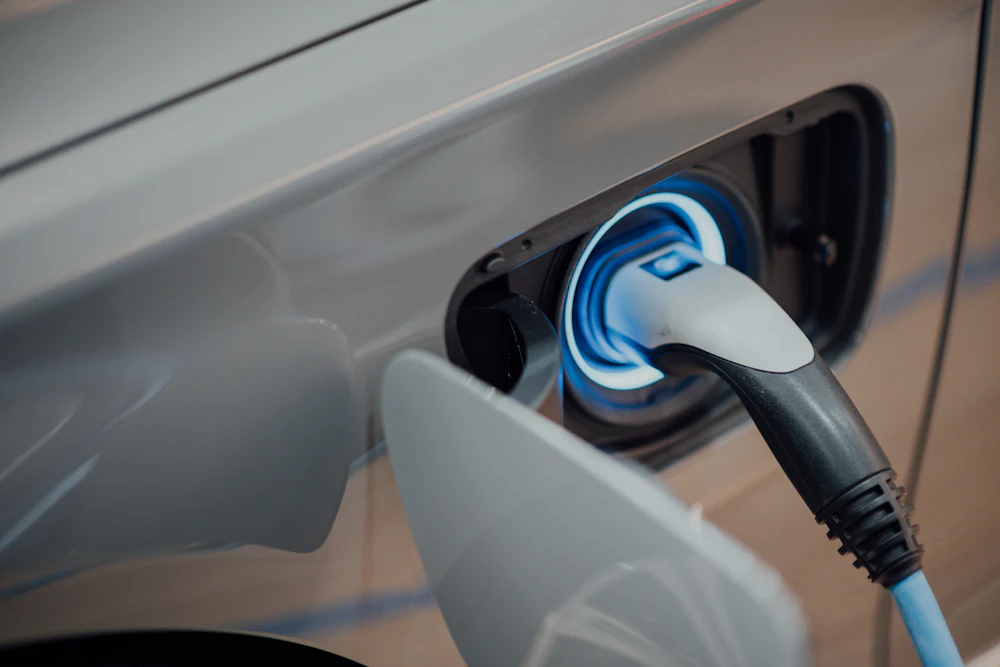
The fuel savings that make electric cars attractive depend almost entirely on where you charge. Plugged in at home overnight, an EV typically costs less than half as much per mile as a gasoline car. Charged mostly at public DC fast chargers, it can cost about the same as gas, sometimes more. This guide puts the options side by side using the EIA's August 2026 average residential price of 18.16¢ per kWh, typical public charging prices and a realistic efficiency of 30 kWh per 100 miles, close to a midsize electric crossover on fueleconomy.gov.
The three ways to charge
Level 1: a standard outlet
Every EV comes with, or can use, a cord that plugs into a regular 120-volt outlet. It draws about 1.4 kW and adds roughly 3 to 5 miles of range per hour. That sounds slow, but 10 hours overnight adds 40 to 50 miles, enough for most daily commutes. Level 1 is slightly less efficient than Level 2 because the car's electronics stay awake longer; expect 12 to 20% of the energy to be lost between the outlet and the battery.
Level 2: a 240-volt charger
A Level 2 charger, wired to a 240-volt circuit like an electric dryer's, typically delivers 7.2 to 11.5 kW and adds 20 to 40 miles per hour. Installation usually costs several hundred to a couple of thousand dollars depending on the distance to your electrical panel and whether the panel needs an upgrade. Losses run around 10%.
DC fast charging
Public DC fast chargers deliver 50 to 350 kW directly to the battery, adding 100 to 200 or more miles in 20 to 30 minutes on cars that support high speeds. Losses inside the car are low, but the price per kWh is high, because the operator pays for expensive equipment, a grid connection sized for a small factory, and demand charges from the utility based on peak power, all spread across relatively few sessions.
Cost per 100 miles, side by side
Each row multiplies 30 kWh per 100 miles by the loss factor for that type of charging and by the price. Gasoline is shown for a 30 mpg car at $3.20 a gallon.
| Where you charge | kWh from the charger per 100 mi | Cost per 100 miles | Cost for 12,000 miles |
|---|---|---|---|
| Home Level 2, super off-peak EV rate (10¢) | 33 | $3.30 | $396.00 |
| Home Level 2, Nevada average (12.7¢) | 33 | $4.20 | $503.71 |
| Home Level 2, U.S. average (18.2¢) | 33 | $5.99 | $719.14 |
| Home Level 1, U.S. average (18.2¢) | 34.5 | $6.27 | $751.82 |
| Home Level 2, Hawaii average (47.2¢) | 33 | $15.57 | $1,868.33 |
| Public Level 2 (30¢) | 33 | $9.90 | $1,188.00 |
| DC fast charging, member price (45¢) | 31.5 | $14.18 | $1,701.00 |
| DC fast charging, pay as you go (60¢) | 31.5 | $18.90 | $2,268.00 |
| Gasoline, 30 mpg at $3.20/gal | 3.33 gallons | $10.67 | $1,280.00 |
At the national average residential rate, home charging costs about $5.99 per 100 miles, roughly 44% less than gasoline. On an off-peak EV rate the saving grows to about 69%. At pay-as-you-go fast-charging prices, the EV costs more than the gasoline car per mile.
A worked example: one month of driving
Suppose you drive 1,000 miles a month, close to the U.S. average, in a car rated 30 kWh per 100 miles.
- Energy the battery needs: 1,000 × 30 ÷ 100 = 300 kWh.
- Energy drawn from a Level 2 charger with 10% losses: 300 × 1.10 = 330 kWh.
- At 18.16¢: 330 × $0.1816 = $59.93 a month.
- At a 10¢ super off-peak price: 330 × $0.10 = $33.00.
- All at a 60¢ DC fast charger: 300 × 1.05 × $0.60 = $189.00.
- Gasoline at 30 mpg and $3.20: 33.3 gallons, $106.67.
The EIA's most recent household survey measured about 2,363 kWh a year of EV charging in homes that charge at home, which works out to roughly 197 kWh a month, consistent with partial home charging and lower-mileage households.
Why fast charging costs so much
Fast-charging prices reflect the economics of the stations, not the cost of the electricity itself. A 150 kW charger can cost well over $100,000 installed, and the operator's utility bill often includes demand charges based on the highest 15-minute power draw of the month, which can be large even if the charger is used only a few times a day. Many networks also charge by the minute in states where selling electricity by the kWh was restricted, which penalizes cars that charge slowly. Membership plans typically cut the per-kWh price by 20 to 30% for a monthly fee, worth it only for frequent users.
Idle fees and charging curves
Most networks add idle fees if you stay plugged in after charging finishes. And because batteries charge more slowly as they fill, the last 20% can take as long as the first 60%. On road trips, charging from about 10% to 70 or 80% and moving on is both faster and cheaper per mile of range added.
What changes the home cost
- Your rate plan. Many utilities offer EV or whole-home time-of-use plans with off-peak prices well below their standard rate. Charging during the evening peak on a TOU plan can cost two or three times as much as charging after midnight.
- Your state. State averages ranged from 12.72¢ in Nevada to 47.18¢ in Hawaii in August 2026, so the same driving costs 3.7 times as much in one state as the other.
- Weather. In freezing weather an EV can use 20 to 40% more energy per mile on short trips, mainly to heat the cabin and battery. Preconditioning while plugged in helps.
- Driving style and tires. Highway speeds above 70 mph and underinflated tires raise consumption noticeably.
- Charging losses. Level 1 loses more than Level 2; very cold garages add losses as the battery is warmed.
Is a Level 2 charger worth installing?
A Level 2 charger saves a little energy compared with Level 1, around 5 percentage points of losses. On 4,000 kWh of yearly charging at the national average that is roughly 200 kWh, or $36.32, not enough on its own to pay for the installation. The real value is convenience: a full charge overnight even after a long day, and easy scheduling to catch a short super off-peak window. If your daily driving is under 40 miles and you can park near an outlet, Level 1 is often enough. Check for utility rebates: many pay part of the cost of a Level 2 charger if you let them schedule it or enroll in an EV rate.
Practical tips for the cheapest charging
- Set the car's scheduled charging to start at the beginning of your utility's off-peak window.
- Charge to 80% for daily use unless you need more; it is quicker and easier on the battery.
- Use DC fast charging for trips, not as your everyday source, unless a free or discounted plan came with the car.
- Compare networks' member and non-member prices before a road trip; prices can differ by 20¢ per kWh at the same location.
- If you live in an apartment, ask about workplace charging, which is often free or priced near residential rates.
Work it out for your car
Enter your miles and your car's kWh per 100 miles in the EV charging cost calculator, pick your state or type your own off-peak price, and compare it with what you would pay for gas. To find the rates utilities near you charge, try the rate finder by ZIP code.
Frequently asked questions
How much does it cost to fully charge an electric car at home?
Multiply the battery capacity you refill by your rate, plus about 10% for losses. Refilling 60 kWh from nearly empty takes about 66 kWh from the wall, which costs $11.99 at the U.S. average of 18.16¢. Most drivers recharge only the miles they used that day, so a typical nightly session is 8 to 15 kWh.
Is it cheaper to charge an EV at night?
Only if your utility charges less at night. On a flat rate, every hour costs the same. On a time-of-use or EV rate, overnight prices can be half or less of peak prices, and some plans have a super off-peak window after midnight under 10¢ per kWh. Scheduling the car to start charging when the off-peak window begins is the single most effective way to cut charging costs.
Why is public fast charging so expensive?
Fast chargers cost tens of thousands of dollars to install and often pay utility demand charges based on their highest power draw each month, which are spread across a limited number of charging sessions. The price reflects the equipment, the grid connection, maintenance and the operator's margin, not just the electricity, so it is commonly two to four times residential prices.
Does charging an EV double my electric bill?
Usually not. Driving 1,000 miles a month at 30 to 35 kWh per 100 miles adds roughly 330 to 385 kWh including losses. The average U.S. home uses about 863 kWh a month, so an EV typically adds 35 to 45% to usage, less for low-mileage drivers and more for long commutes or larger vehicles.